Building a 72-archetype
identity system from scratch.
BNA72 began with a larger question: could an identity system capture enough human nuance to be useful without reducing a person to one type? Over three years, I built the architecture, archetypes, assessment, behavioral library, brand and product that now operate at BNA72.com.
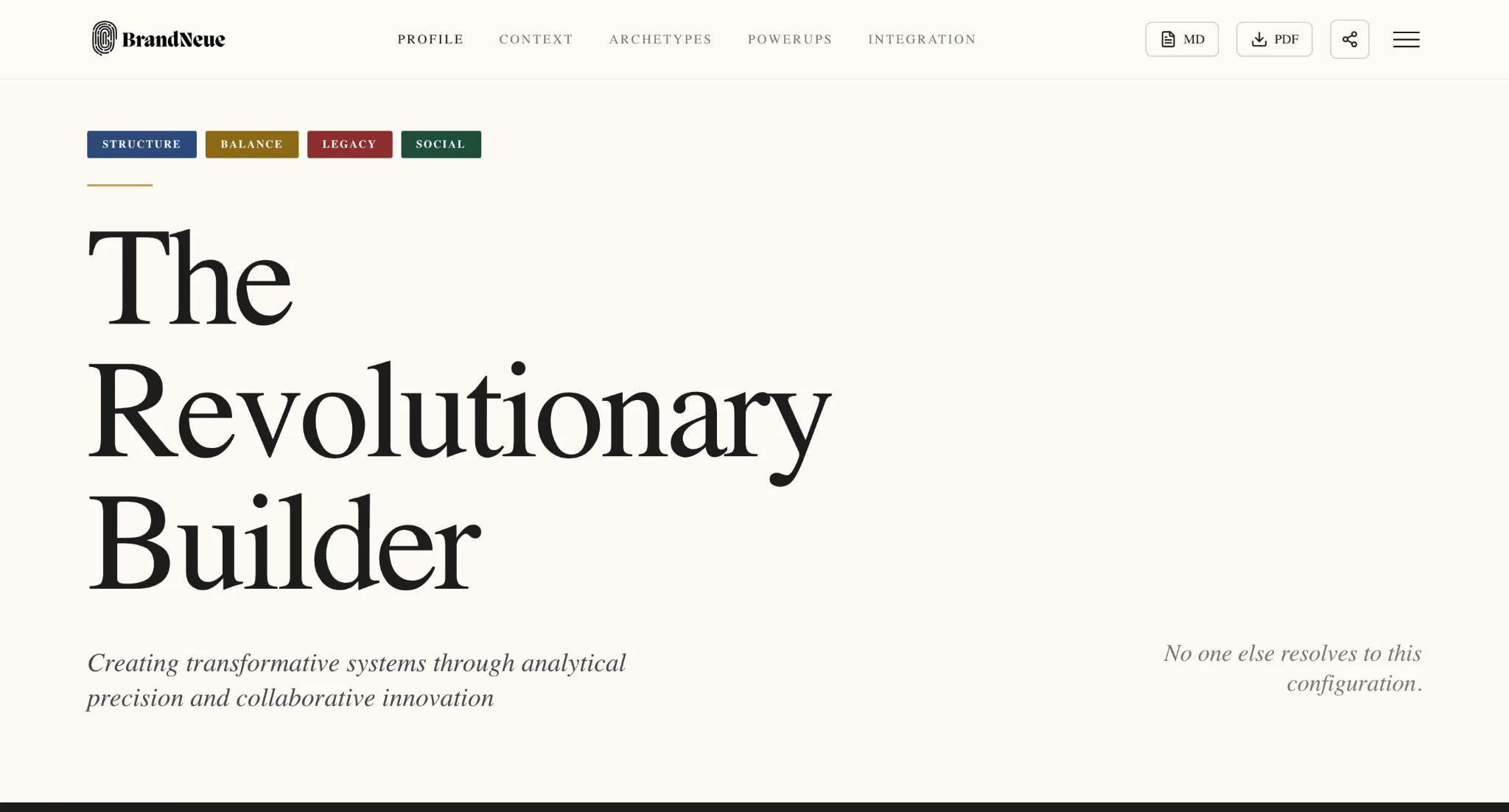
One person.
Four domains.
Twelve ranked positions.
BNA72 maps identity across Structure, Balance, Legacy and Social rather than assigning one universal type. Each domain ranks a primary, secondary and tertiary archetype from eighteen possibilities, creating a twelve-position constellation across seventy-two archetypes.
Experience BNA72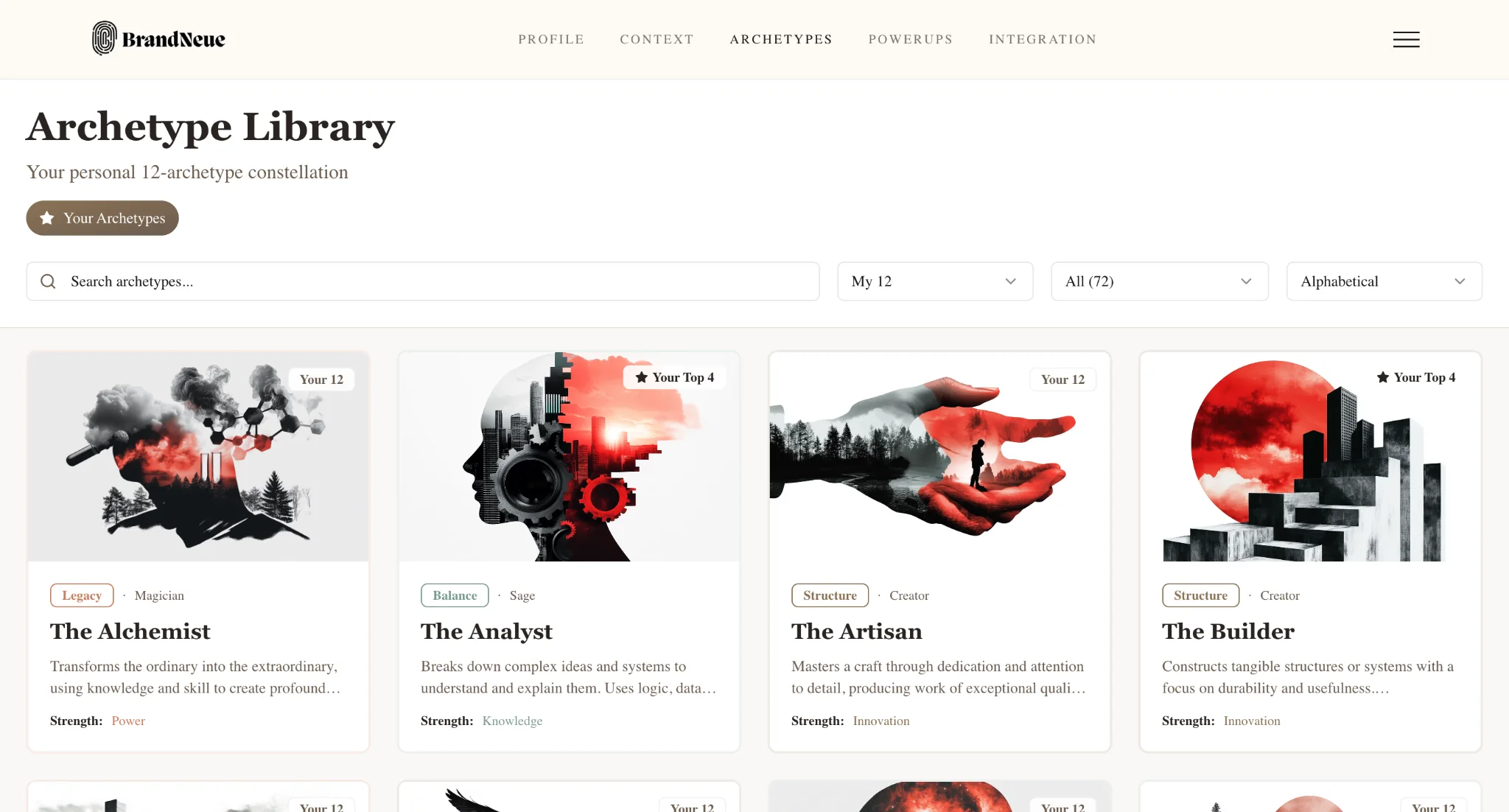
A person should not collapse into one type.
Most personality systems become useful by simplifying. One label. One quadrant. One dominant style. I wanted to start from the opposite premise: the same person can express different patterns depending on what part of life is being asked of them.
The challenge was not simply inventing more archetypes. It was creating enough structure that seventy-two archetypes could remain meaningfully distinct, combine without becoming contradictory, and eventually produce something software could reason from.
First came the architecture.
The system was organized into four domains, each asking a different question of the same person. Three ranked positions inside each domain preserve dominant patterns and supporting tensions rather than pretending identity has a single center.
How you build
Decision systems, frameworks and the logic underneath the work.
How you hold
Energy, attention and the pace your life can actually sustain.
What you leave
What you refuse, carry forward and choose to make durable.
How you meet
Voice, relationship and how you think in the presence of others.
Seventy-two names are easy. Seventy-two distinct behaviors are not.
The system only has value if neighboring archetypes behave differently for reasons more specific than tone or vocabulary.
Each archetype was developed with explicit boundaries against its nearest neighbors, behavioral drivers, fears, value priors, decision patterns and claims written strongly enough that later evidence could overturn them.
Twelve cluster boundary maps were used to test confusion inside the system. The goal was not to make every archetype sound unique. It was to make the underlying behavioral cuts legible enough to survive comparison.


AI solved the production constraint.
It did not solve the accountability constraint.
Five archetypes could be developed at full depth manually. Sixty-seven more created a different problem. I used AI to scale the authoring, but built a governance layer so generated judgment never became invisible judgment.
Treat AI like a delegate, not a writer.
A writer is supervised by reading the output. A delegate is governed by making the decisions visible, attributable and reversible.
Provenance
Fields remained distinguishable by origin: source material, authored content, constraint, delegated judgment or founder ruling.
Decision ledger
Consequential AI-made rulings were logged separately, including the condition that should cause each decision to be reconsidered.
Mechanical gates
Machine-checkable conformance ran automatically so human attention stayed on the decisions that actually required judgment.
Human review
Founder judgment was consolidated and ordered by risk rather than consumed batch by batch in production order.
Governance mattered because the work was already capable of drifting.
The goal was not to prove the AI was right. It was to make being wrong visible early enough to correct.
Four of the five original pilot modules had lost authored source values.
The fidelity audit traced the error to a structural mismatch: the authoring format allowed more values than the machine format could store. That guaranteed silent loss. Finding it changed the format and proved why auditability had to be designed into the system rather than added after the work was finished.
The intellectual architecture still needed a brand people could enter.
BNA72 was developed as a consumer-facing product, not a research artifact. The product language, assessment experience and visual system were built to communicate depth without pretending certainty.
Not a personality test.
The product is framed around giving AI the context and subtext needed to reason from the person rather than a generic user model.
One constellation, not one label.
The assessment resolves a twelve-position pattern across four domains and exposes the interactions between them.
A foundation AI can use.
The current BNA72 foundation produces a personalized profile designed to load into the AI tools someone already uses.


An original identity system became a live product with its own behavioral architecture, assessment, brand and AI-readable foundation.
The project moved from an idea about human complexity to a seventy-two-archetype architecture, a governed behavioral library, an operating assessment and a commercial product people can experience today.
The current product generates a roughly 30,000-word BNA72 foundation from a 60-minute assessment and packages the result for use across modern AI tools.
The important distinction: the 574.6 trillion figure describes the resolution of the architecture, not a claim that the assessment has scientifically established that level of predictive accuracy.
Original IP becomes more valuable when software can actually use it.
BNA72 was not a matter of wrapping an existing assessment in AI. The work was inventing the underlying system, defining the behavioral resolution, building the product around it and then making that foundation machine-readable enough to power what came next.
That is the kind of AI work I am most interested in: finding the valuable thing a business knows, structuring it well enough to become infrastructure, and building the experience around it.
Have expertise or IP that should become a product?
I can help turn the underlying thinking into a system people and AI can actually use.